Compound Interest Calculator
Simulate the geometric growth of your assets. This Compound Interest Calculator employs a standard compounding model to estimate the future value of a lump-sum investment across different return rates and timeframes. Unlike Simple Interest, compound interest reinvests earnings into the principal, generating exponential growth. Simply enter your initial principal and expected annualized return to forecast your future wealth.
Parameter Guide: How to Calculate Accurately?
Please enter the following values for your simulation:
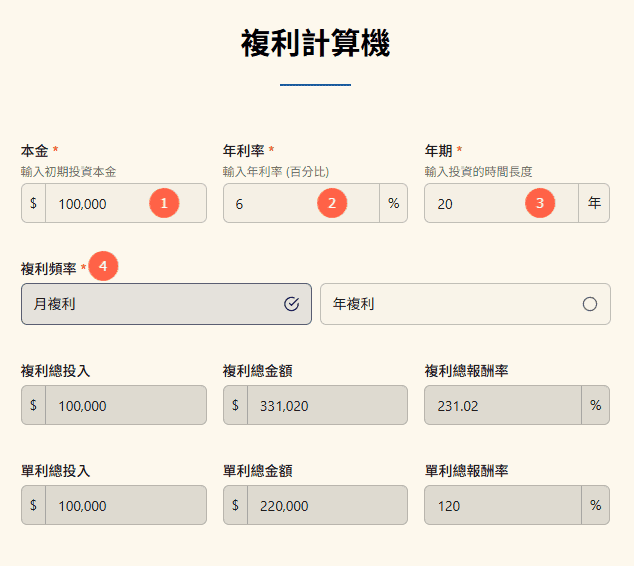
- Principal: The initial lump sum you intend to invest (e.g., $10,000).
- Annual Rate: Expected annualized return. Reference data: Taiwan Weighted Index averages about 7%~9%, S&P 500 about 8%~10%, while time deposits are about 1.5%.
- Year: The duration of your investment in years (e.g., 20 years).
- Frequency: How often interest is added to the principal. Select "Annually" for general stock investments, or "Monthly" for high-yield savings accounts. Higher frequency results in a stronger compounding effect.
Input your figures to instantly see: Total Investment, Final Value, and Total Return Rate. The tool also displays Simple Interest Total and Simple Interest Return for comparison.
The Mathematics Behind Compound Interest
The formula for the future value of compound interest is:
Where P is the principal, r is the annual interest rate, n is the number of times interest is compounded per year, and t is the time in years.
This formula highlights that time t is an exponential factor, meaning the longer the investment horizon, the steeper the asset growth curve becomes.
The Rule of 72: Quickly Estimate Doubling Time
Even without a calculator, you can estimate how many years it will take for your assets to double using the "Rule of 72":
Years to Double ≈ 72 ÷ Annual Rate of Return
For example: With an 8% annual return, your assets will double in approximately 9 years (72 / 8 = 9). This rule helps you quickly assess the feasibility of your investment goals.
Starting small? If you plan to invest a fixed amount from your salary each month, please switch to our [Dollar-Cost Averaging (DCA) Calculator] for cash flow simulations.
Compound Interest Calculator FAQ
Q1: Does choosing "Annually" or "Monthly" for Compounding Frequency make a difference?
Yes. Compounding frequency represents how many times interest is rolled into the principal within a year. Higher frequency amplifies the compounding effect.
For example, with a 10% annual rate:
- Daily (365 times/year): Effective Annual Rate (EAR) is approx. 10.51%.
- Annually (1 time/year): EAR is 10%.
- Monthly (12 times/year): EAR is approx. 10.47%.
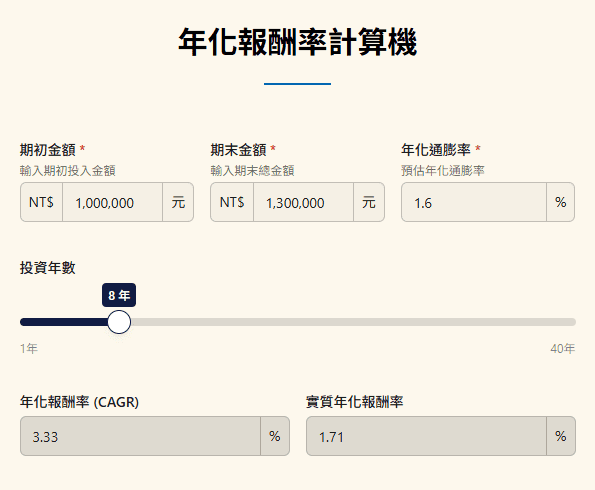
Q2: How do I calculate the Real Rate of Return adjusting for inflation?
Long-term nominal returns are eroded by inflation. To calculate real purchasing power, use this formula to adjust your input rate:
Real Rate ≈ ((1 + Nominal Rate) ÷ (1 + Inflation Rate)) - 1
Example: Nominal return 8%, Inflation 3% → Real rate ≈ 4.85%.
Enter 4.85% in the "Annual Rate" field to see the inflation-adjusted asset value.
Q3: Is the Rule of 72 accurate?
The Rule of 72 is a quick estimation. It is highly accurate for returns between 6% and 10%. However, the margin of error increases with extremely high (e.g., >20%) or low rates. For precise financial planning, rely on the mathematical model in this calculator.
Related Tools
Want to simulate the long-term effect of monthly contributions? Use: 👉 DCA Compound Interest Calculator
Calculate retirement funds precisely using real rates of return, supporting two scenarios:
👉 Retirement Calculator