Structured Product Calculator: MTM Valuation and Payoff Simulator for ELNs and PGNs
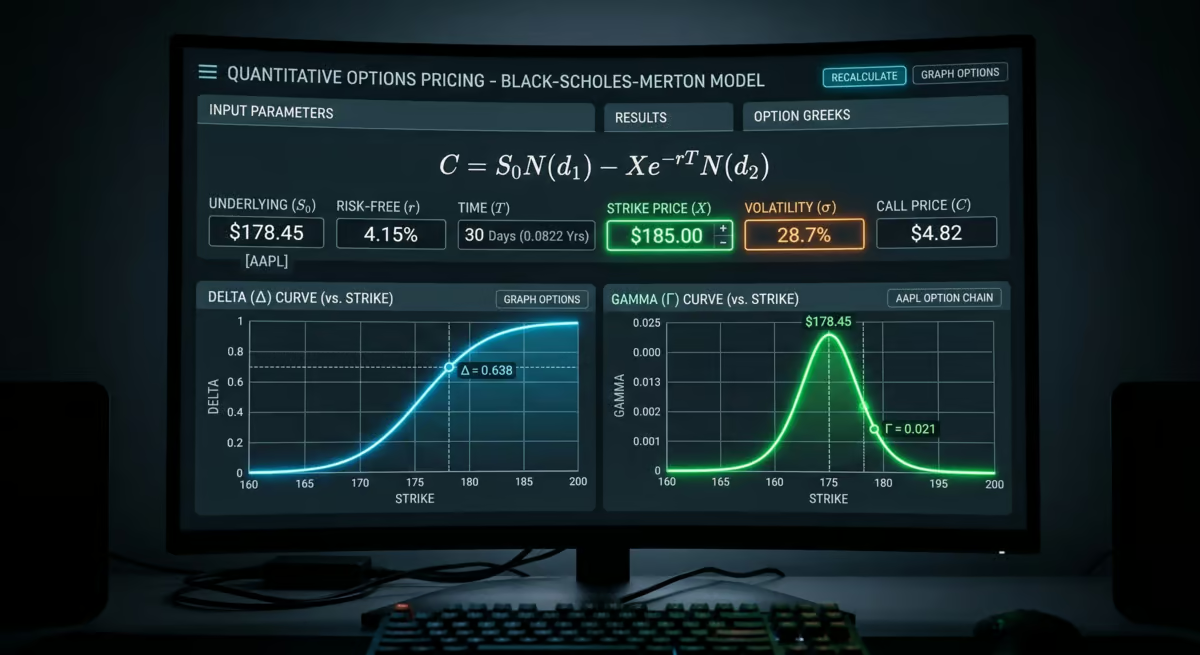
This calculator is specifically developed for financial engineering learners and structured product investors. By integrating the Black-Scholes option pricing model with bond discounting logic, this tool provides the Mark-to-Market (MTM) valuation of structured products over their contract lifecycle, while also supporting scenario simulations for payoff at maturity.
By decoupling the contract into a "Fixed Income Component (Bond)" and a "Derivative Component (Option)", investors can accurately assess the true theoretical value of Equity Linked Notes (ELN) and Principal Guaranteed Notes (PGN) throughout their holding period.
For deeper insights into the pricing formula derivation, market quoting conventions (such as the percentage of par quote), and the dynamic hedging strategies of issuers, please refer to Quants Note's core theoretical article: How to Value ELNs and PGNs? An Analysis of Structured Product Quoting Conventions and Hedging Positions.
Structured Product Calculator Core Parameters and Setup Guide
This calculator interface is built using the SureForms plugin, combined with a backend numerical computing engine to provide real-time interactive calculations and data visualization. Please configure the following parameters in order. The system will instantly recalculate the MTM value and update the charts and component breakdown tables below based on your inputs.
Product Selection and Issuance Scenarios
- Product Type: Toggle the calculation mode between ELN or PGN.
- ELN Specific Settings (Par/Discount Issue): When switched to ELN mode, the calculator provides radio button options for issuance scenarios, reflecting different quoting conventions in practice.
- Par Issue: Investors pay 100% of the notional principal upfront. The issuer converts the premium received from the investor's short put position into an enhanced coupon rate, which is paid out at maturity.
- Discount Issue: The issuer deducts the option premium directly from the initial principal. The investor pays less than the notional principal upfront (buying at a discount) and receives 100% of the notional principal at maturity if no conversion occurs.
Basic Market Variables: Distinguishing Risk-Free Rate from Bond Rate
In practical valuation, the fixed-income and option components of structured products are subject to different pricing benchmarks. This calculator provides distinct interest rate input fields:
- Risk-Free Rate: Used exclusively in the Black-Scholes model to calculate the theoretical value of the embedded option within the structured product. This value affects the expected drift of the asset price and the discounting of the expected option payoff. In practice, SOFR or government bond yields of matching maturity are often referenced.
- Bond Rate: Used exclusively to calculate the interest and present value discount of the bond component. This figure reflects the issuer's funding cost or credit risk premium. Decoupling the bond rate from the risk-free rate allows for a more accurate simulation of the true MTM value under specific broker issuance conditions.
- Initial Spot & Strike Ratio: Set the entry benchmark and the settlement trigger price at maturity for the underlying asset.
- Investment Days: The core parameter for calculating time decay (Theta) and the bond discount factor.
- Volatility: The critical factor determining the value of the embedded option. Input the expected volatility figure, and the system will feed it into the pricing model to calculate the option premium.
MTM Valuation Analysis: Deconstructing Bond and Option Components
Structured products are inherently combinations of fixed income and derivatives. This tool displays the current value of these two components in the charts, illustrating their respective contributions to the overall MTM.
Valuation Logic for Equity Linked Notes (ELN)
The theoretical framework of an ELN involves the investor buying a bond while simultaneously selling a put option to the issuer. Its MTM valuation formula is:
- Fixed Income Component : The present value of the bond and accrued interest calculated based on the "Bond Rate" and days to maturity.
- Option Component : The value of the put option calculated by feeding the "Risk-Free Rate" and "Implied Volatility" into the BS model. Since the investor holds a short position, an increase in market volatility or a drop in the underlying asset price will increase the Put's value, thereby decreasing the overall MTM value of the ELN (as it is a subtraction in the formula).
In a discount issue scenario, if the underlying asset's price falls significantly below the strike price, the embedded put option becomes Deep In-The-Money. Consequently, will increase substantially, accurately reflecting the unrealized loss the investor faces as their principal is converted into physical shares.
Valuation Logic for Principal Guaranteed Notes (PGN)
The core mechanism of a PGN uses the majority of the capital to purchase zero-coupon bonds to lock in the principal guarantee at maturity, while allocating the remaining funds to buy a call option (Long Call) to participate in the market's upside. Its MTM valuation formula is:
- Fixed Income Component : Discounted based on the "Bond Rate". This portion of value gradually converges toward the guaranteed principal amount as time passes and approaches maturity (Pull-to-par effect).
- Option Component : Calculated based on the "Risk-Free Rate". Since the investor holds a long position, an increase in the underlying asset's price or market volatility will drive up the Call's value, directly boosting the MTM value of the PGN. The Participation Rate serves as a multiplier for the quantity of this option position.
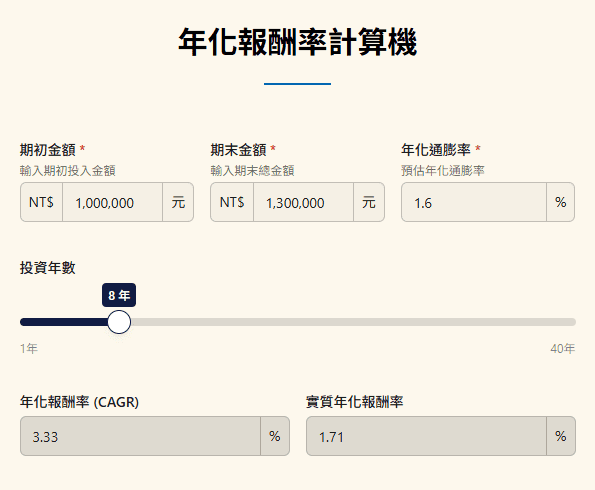
When evaluating the capital efficiency of a PGN, it is highly recommended to concurrently use the Compound Annual Growth Rate (CAGR) Calculator to compute the opportunity cost of investing the same capital in risk-free fixed deposits over the identical period.
Risk Matrix and Asset Allocation Considerations
The MTM value outputted by the calculator provides an objective theoretical benchmark (Fair Value). In practical trading, investing in structured products still requires weighing external risk factors that are not directly displayed on the payoff chart at maturity.
Issuer Credit Risk
Structured products are unsecured debt instruments. Whether it's an ELN or a PGN, investors bear the default risk of the issuing broker or bank. If the issuer goes bankrupt during the contract period, investors might face a total loss of their principal, even if the underlying asset performs exceptionally well. When assessing such products, the issuer's CDS (Credit Default Swap) spread serves as an objective reference indicator.
Secondary Market Liquidity Discount
Most structured products are customized OTC (Over-The-Counter) contracts, lacking active secondary market quotes. If an investor needs to redeem early before maturity, they must accept the issuer's unilateral quote. When calculating the early redemption value, the issuer will factor in the current interest rate environment, underlying asset volatility (Vega), time decay (Theta), and deduct corresponding unwinding costs. The early redemption price is often significantly lower than the theoretical option pricing model's value, resulting in an actually realized return rate that is far below the calculator's expected figures at maturity.
For deeper technical details regarding product design and quoting, you can further explore the site's financial engineering discussion on Homogeneous Hedging Strategies and Product Issuance.
Frequently Asked Questions (FAQ)
Q1: What is the calculation difference between a discount issue and a par issue for an ELN?
A: The two reflect different quoting conventions. In a par issue scenario, the investor pays 100% of the notional principal upfront, and the issuer converts the premium received from the investor's short option into a higher coupon rate at maturity. In a discount issue scenario, the issuer deducts the premium directly from the initial principal payable, allowing the investor to establish the position at a cost lower than the face value. This calculator will automatically adjust the initial invested capital and the fixed-income discounting benchmark based on your selection.
Q2: Why does the MTM value before maturity differ from the final Payoff figure at maturity?
A: The MTM (Mark-to-Market) value reflects the theoretical unwinding price under current market conditions, incorporating fluctuations in the option premium caused by time value (Theta) and implied volatility (Vega). The payoff at maturity solely depends on the relative relationship between the underlying asset's final settlement price and the strike price, completely excluding any time value.
Q3: Why must the risk-free rate and bond rate be set separately in the calculator?
A: The risk-free rate is used exclusively in the Black-Scholes model to calculate the asset's expected drift rate and the option's value. The bond rate is used to calculate the discounted present value of the fixed-income component, reflecting a specific issuer's actual funding cost and credit risk premium. Setting them separately enables the precise calculation of the true theoretical valuation for individual broker contracts in the Over-The-Counter (OTC) market.
Extended Financial Tools and Quantitative Resources
After evaluating the expected return and MTM value of structured products, it is advisable to objectively compare their capital efficiency against other investment portfolios. You can utilize various financial engineering tools available on Quants Note to conduct a more comprehensive opportunity cost analysis:
- Compound Annual Growth Rate (CAGR) Calculator: Converts the absolute return of an ELN or PGN into a standard annualized rate. This figure can be directly benchmarked against the long-term performance of risk-free fixed deposits, long-term government bonds, or broad market indices.
- Dollar-Cost Averaging (DCA) Compound Interest Calculator: Simulates the long-term growth curve of funds invested at a fixed frequency. It helps evaluate the difference in asset accumulation efficiency between a large lump-sum purchase of a structured product and establishing a broad market ETF position in batches.
- What are Delta, Gamma, and Vega? An Analysis of Derivatives Risk Management: Through this technical article, gain a deeper understanding of the mathematical definitions of Greek parameters and master the underlying logic of how volatility and time decay impact derivatives pricing.